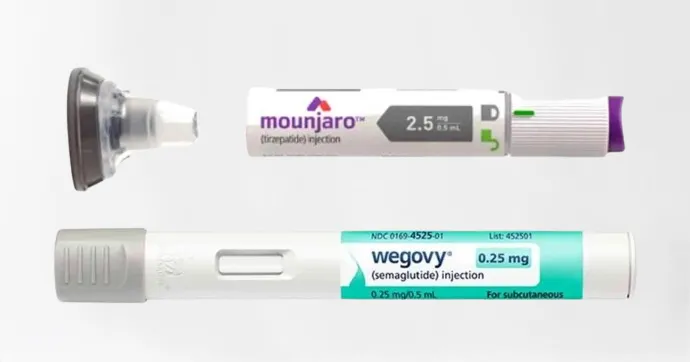
If you’ve spent any time researching weight loss injections, you’ve almost certainly come across two names: Mounjaro (tirzepatide) and Wegovy (semaglutide 2.4mg). Both have generated serious excitement — and serious debate — in obesity medicine. Both work by targeting appetite-regulating hormones. And both produce weight loss results that would have seemed implausible just a decade ago.
But here’s what most comparison articles don’t tell you: these two treatments work differently at a biological level, they suit different patients, and their side effect profiles, costs, and availability vary considerably. Choosing between them isn’t just about which one loses more weight on average. It’s about which one is right for you.
This guide breaks down everything you need to know — the clinical data, the practical differences, the costs, and who each treatment is best suited for.
Mounjaro vs Wegovy: At a Glance
Before diving into the detail, here’s a side-by-side comparison with the other major prescription options — Ozempic (semaglutide 1mg) and Saxenda (liraglutide) — included for context.
| Mounjaro (tirzepatide) | Wegovy (semaglutide 2.4mg) | Ozempic (semaglutide 1mg) | Saxenda (liraglutide) | |
| Drug class | GIP + GLP-1 agonist | GLP-1 agonist | GLP-1 agonist | GLP-1 agonist |
| Average weight loss | ~20–22% | ~15% | ~5–8%* | ~5–7% |
| Injection frequency | Weekly | Weekly | Weekly | Daily |
| Licensed for weight loss | Yes (UK) | Yes (UK/US) | Off-label | Yes (UK/US) |
| NHS availability | Limited pilot | Limited pilot | No | No |
*Ozempic is licensed for type 2 diabetes, not weight loss. Weight loss figures reflect observed outcomes in diabetic patients.
How Do Mounjaro and Wegovy Actually Work?
Both medications belong to a class of drugs called GLP-1 receptor agonists, which mimic a naturally occurring gut hormone (GLP-1) that tells your brain you’re full. They slow the rate at which food leaves your stomach, reduce appetite, and help regulate blood sugar. According to NICE guidance on obesity management, these treatments are recommended alongside lifestyle interventions for adults with a BMI of 30 or above.
The critical difference? Mounjaro goes further. While Wegovy targets only the GLP-1 receptor, Mounjaro activates both GLP-1 and GIP receptors — GIP being another gut hormone involved in insulin secretion and fat metabolism. This dual action is why tirzepatide tends to produce greater weight loss: it’s essentially pressing two buttons instead of one.
Think of it like this: if Wegovy is a single-engine plane, Mounjaro is a twin-engine. Both will get you there — but one has more power.
The Clinical Evidence: What Does the Data Actually Show?
Mounjaro (Tirzepatide) — The SURMOUNT Trials
The headline figures from the SURMOUNT-1 trial are striking. In adults with obesity but without type 2 diabetes, participants taking the highest dose of tirzepatide (15mg weekly) lost an average of 20.9% of their body weight over 72 weeks. That’s roughly 23kg for a 110kg person.
At lower doses, results were still significant — 16% at 5mg and 19.5% at 10mg. Most participants lost at least 5% of their body weight, and roughly a third lost 25% or more. These are numbers that were previously only associated with bariatric surgery.
Wegovy (Semaglutide 2.4mg) — The STEP Trials
Wegovy’s approval was built on the STEP clinical trial programme, which demonstrated average weight loss of approximately 14.9% of body weight over 68 weeks — significantly more than placebo. That translates to around 15kg for a 100kg person.
Critically, Wegovy also showed cardiovascular benefits. The SELECT trial found a 20% reduction in major adverse cardiovascular events among patients with existing heart disease — a landmark finding that strengthened its clinical case considerably.
Head-to-Head: What the SURMOUNT-5 Trial Tells Us
In 2024, the first direct head-to-head trial comparing tirzepatide and semaglutide was published. The results were clear: Mounjaro outperformed Wegovy on weight loss, with participants losing an average of 20.2% vs 13.7% respectively. Mounjaro patients were also significantly more likely to achieve 25% or greater weight loss.
That said, this doesn’t make Wegovy ineffective. A 13–15% average weight loss is still clinically meaningful and life-changing for many patients. And Wegovy has a longer track record of real-world use.
Side Effects: What to Expect With Each Treatment
Both medications share a similar side effect profile — not surprising given their shared GLP-1 mechanism. The most common issues are gastrointestinal: nausea, vomiting, diarrhoea, and constipation. These are most pronounced during the dose escalation phase and tend to ease once you reach a stable dose.
Many people starting Mounjaro report that the nausea feels slightly more intense at first, likely due to the dual hormone mechanism. A common concern among Wegovy users is that nausea can persist longer in some individuals, particularly at the higher 2.4mg maintenance dose.
More serious but rare side effects include:
- Pancreatitis (inflammation of the pancreas)
- Gallbladder problems, including gallstones
- A possible association with thyroid C-cell tumours (noted in animal studies — currently flagged as a theoretical risk in humans)
- Changes in heart rate
Both carry a black box warning regarding thyroid tumours based on animal studies. The FDA prescribing information for Wegovy and the equivalent Mounjaro documentation both outline contraindications including personal or family history of medullary thyroid carcinoma.
The key message: side effects are manageable for most people, especially when dose titration is done carefully. Speak to a prescriber about your individual risk factors before starting either treatment.
Who Is Each Treatment Best Suited For?
Mounjaro May Be a Better Fit If…
- You have type 2 diabetes or insulin resistance alongside obesity — tirzepatide’s dual mechanism is particularly beneficial for metabolic health
- You have a higher starting BMI and are targeting more significant weight loss
- You’ve previously tried semaglutide-based treatments without achieving desired results
- You want the most clinically studied high-efficacy option available
Wegovy May Be a Better Fit If…
- You have established cardiovascular disease — the SELECT trial cardiovascular benefit data is specific to semaglutide
- You have a longer clinical track record — Wegovy has more real-world safety data accumulated over time
- You’re already using Ozempic for diabetes and want to transition to a weight-licensed semaglutide product
- Cost is a primary consideration — availability and pricing can vary between the two
Both options sit within what the NHS clinical weight management programme considers evidence-based treatment. Your eligibility will ultimately depend on your BMI, co-existing conditions, and clinical assessment.
How Much Do They Cost in the UK?
Here’s the honest picture for UK patients: neither Mounjaro nor Wegovy is routinely available on the NHS at the time of writing. Both have been approved, and NHS pilot programmes are underway, but widespread prescribing remains limited.
For private prescriptions, current prices vary by dose and supplier, but as a general guide:
- Mounjaro: typically £150–£250 per month, depending on dose
- Wegovy: typically £150–£230 per month, depending on dose
These figures are approximate and change frequently as the market evolves. Always verify current pricing through a registered UK prescriber or registered online pharmacy. Prices for Saxenda (liraglutide) tend to be lower but require daily injections — worth considering if budget is a concern.
It’s also worth keeping an eye on NHS guidance as NICE’s recommendations are updated. NICE’s guidance on semaglutide (Wegovy) was published in 2023, and Mounjaro guidance is expected to follow.
What About Ozempic and Saxenda?
No honest comparison of weight loss injections is complete without mentioning the other two major treatments in this space.
Ozempic (semaglutide 1mg) is the same molecule as Wegovy but at a lower dose, licensed for type 2 diabetes rather than weight management. Many patients use it off-label for weight loss, though this sits outside its licensed indication. It typically produces 5–8% weight loss — meaningful, but considerably less than the 2.4mg Wegovy dose.
Saxenda (liraglutide 3mg) was the first GLP-1-based weight loss injection and is injected daily rather than weekly. It produces around 5–7% average weight loss — modest compared to the newer weekly options, but still clinically relevant and well-tolerated by many patients who struggle with the side effect profile of tirzepatide or semaglutide.
If Mounjaro and Wegovy are the gold standard today, Saxenda and Ozempic remain legitimate options — particularly where cost, tolerability, or availability is a factor.
Frequently Asked Questions
Q: Is Mounjaro stronger than Wegovy?
In terms of average weight loss, yes — clinical trials show Mounjaro produces greater weight reduction than Wegovy. The SURMOUNT-5 head-to-head trial found average weight loss of around 20% with tirzepatide versus approximately 14% with semaglutide 2.4mg. This is largely attributed to Mounjaro’s dual action on both GLP-1 and GIP receptors. However, ‘stronger’ doesn’t automatically mean ‘better for you’ — your suitability depends on your health profile, any co-existing conditions, and how you respond to the medication.
Q: Can I get Mounjaro or Wegovy on the NHS?
Currently, both are available on the NHS only through specialist weight management services and pilot programmes — not via routine GP prescription. NICE has approved Wegovy for NHS use in specific circumstances, and Mounjaro guidelines are in development. Most people accessing these treatments in the UK currently do so via private prescription through registered online clinics or specialist services. This is expected to change as NHS rollout expands over the coming years.
Q: What is the difference between Wegovy and Ozempic?
Both contain semaglutide, but they are not the same product. Wegovy is licensed specifically for chronic weight management and uses a higher dose — up to 2.4mg weekly. Ozempic is licensed for type 2 diabetes at doses up to 1mg (or 2mg in some markets). Wegovy’s higher dose is what drives its superior weight loss outcomes. Using Ozempic for weight loss is considered off-label prescribing, and the doses are lower than those shown to produce maximum weight loss benefit.
Q: How quickly will I lose weight on Mounjaro or Wegovy?
Most people start to notice appetite suppression within the first few weeks, but meaningful weight loss typically becomes apparent after 8–12 weeks as the dose is titrated upward. Both medications use a slow escalation schedule to reduce side effects. The full weight loss benefit tends to emerge over 6–12 months of consistent use. Individual results vary based on diet, activity level, starting weight, and metabolic factors.
Q: What happens if I stop taking Mounjaro or Wegovy?
This is one of the most important questions to ask before starting. Both medications work only while you’re taking them — they do not cure obesity. Studies show that most patients regain a significant proportion of lost weight within a year of stopping treatment. This is not a personal failure; it reflects the chronic nature of obesity as a condition. Current thinking in obesity medicine is that many patients will need long-term or indefinite treatment, similar to how someone with hypertension takes blood pressure medication indefinitely.
Q: Are there any people who should not take Mounjaro or Wegovy?
Yes. Both medications are contraindicated in people with a personal or family history of medullary thyroid carcinoma or Multiple Endocrine Neoplasia syndrome type 2. They are not recommended during pregnancy or breastfeeding. People with a history of pancreatitis, severe gastrointestinal disease, or diabetic retinopathy (for semaglutide) should discuss the risks carefully with their prescriber. A thorough medical assessment is essential before starting either treatment.
Additional Resources
🔗 NHS: Treatment Options for Obesity
🔗 NICE Guideline NG246 – Obesity in Adults (2023)
🔗 NICE Technology Appraisal: Semaglutide (Wegovy) for Weight Management